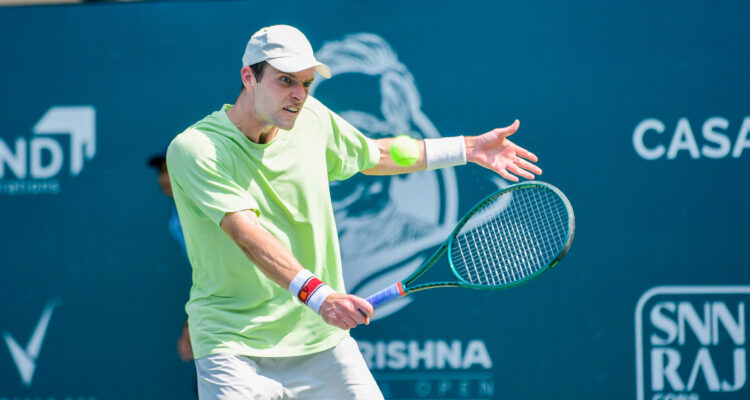
BENGALURU, May 22, 2026 (by Anirudh Suresh)
Every kid grows up dreaming of playing Wimbledon, and Alastair Gray was just 24 years old, still a rookie with not much experience at the professional level, when he got to live the ultimate dream after he was handed a main draw wildcard at The Championships in 2022.
“Wimbledon was amazing, something I’ll never forget,” Gray recalled in an interview to Tennis TourTalk during the S.M. Krishna Memorial Open in Bengaluru, India.
“One year out of college, all my friends and family being there – it was an amazing moment.”
A second round exit at the hands of 11th seed Taylor Fritz meant that there was no ‘fairytale run’, still, it was an experience of a lifetime for a just-turned-pro born in Twickenham.
Four years on, Wimbledon 2022 remains Gray’s only singles main draw appearance in a Slam, but he’s on the rise again after a tough couple of years, having won a staggering eight ITF World Tennis Tour titles since the start of 2025. The 27-year-old, currently ranked 287 in the world, is slowly but steadily making his way up the rankings ladder, edging closer to making the qualies cutoff for Grand Slams.
Sieh dir diesen Beitrag auf Instagram an
Naturally, the tendency for any player in a situation like this would be to eye the Top 200 to ‘guarantee’ Grand Slam qualies participation. Basically, chasing the numbers to chase the Grand Slam high.
However, Gray is built different: his mantra of success instead involves him actively and consciously eliminating things such as prize money, points and rankings, with the sole focus being on enjoying his Tennis.
“There’s numbers next to everyone’s names and there are cutoffs for tournaments and that will always be there. So there will inevitably be external pressure and other variables,” he said.
“But if you pay too much attention to that stuff, it can end up working against you. I’m on my own journey, and whether I get to Grand Slams or not is not the reason I play Tennis. I play for other reasons – I love the game and I enjoy competing.
“I would absolutely love to play Grand Slams but it’s not the reason why [I’m playing Tennis]. I’m open to anything that the future has to offer. Right now I’m really enjoying my Tennis and taking it one week at a time.”
Gray’s results serve as proof for the fact that this mindset is taking him to new heights. The former Texas Christian University athlete is getting ever-so-closer to re-entering the Top 250, and is into the semi-final of an ATP Challenger for the first time in his career.
He’s made winning a habit, as is evident from the above-mentioned statistic of him having won eight titles on the ITF Pro Circuit in the last 16 months.
This frame of mind to treat every match — across levels — as the same is significantly aiding Gray to smoothly transition from the ITF to the Challenger circuit.
“Whether it’s Futures or Challengers it’s just the name of the tournament, you know. Every match is its own individual thing,” he said.
“There are better players at Challengers, so it’s definitely going to be tougher to win Challenger tournaments. But at the end of the day, regardless of whether it’s an ATP tournament or a Challenger or a Future, it’s just a Tennis match. And my process is the same for any match I play, regardless of who it is or what the name of the tournament is.”
And while Gray has certainly leveled up and evolved as a player, he believes that his mental clarity is the single biggest driving force behind his recent success.
“It’s difficult to judge [whether I’m playing the best Tennis of my life] but I like the improvements that I’ve made in my game since I’ve come out of College, especially in the last couple of years,” the 27-year-old said.
“Mentally I’m really enjoying playing. I’m probably in as good a mental space as I’ve ever been.”
Gray’s Evolution as a player, and the one-handed backhand weapon
For the longest time, Gray came with the peculiar description of being a ‘serve and volleyer’, and the profiling was not inaccurate by any means.
However, with time, the 27-year-old’s game has shown significant evolution, to the extent that he can no longer be considered a serve and volleyer.
Take the ongoing S.M. Krishna Memorial Open in Bengaluru, for instance. In his first round match against young Aradhya Kshitij, Gray came to the net a total of just six times. That figure rose to 11 in the Round of 16 clash against Dominic Palan, but the figure was still a far cry from what a typical serve and volleyer would dish out.
Talking about his gamestyle, Gray revealed that the slow nature of courts — across continents and surfaces — have, in a way, positively forced him to adapt and evolve his game.
“In the past I served and volleyed a lot more. The game is getting a lot slower,” he said.
“The balls are getting a lot slower as well, so it’s that much harder to serve and volley. So because of the conditions on offer I’ve had to evolve other parts of my game, which has been a great lesson and I’ve learnt a lot from that.”
The 27-year-old is also a rare profile in the sense that he possesses a one-handed backhand, a rarity for a Men’s professional player in 2026. A while back, Denis Shapovalov spoke about the disadvantage of having a one-handed backhand — claiming that it helps to have the ‘extra hand’ — but Gray considers it a weapon, and one of his best shots.
“In terms of my backhand, there are obviously not a lot of people using the one-handed backhand. Some of the positives of employing a one-handed backhand is that you can create a lot more racket head speed, create more angle, create more power. These things coupled with the slice make my backhand potent,” Gray said.
“It’s not as compact on returns, and consistency is an issue, but that’s not the way I play anyway. I’d say my backhand is probably one of my best shots. I don’t think I regret not having a two-handed backhand.”
From peaking at No.237 in September 2022 to sliding to No.650 at the start of 2025 to now making his way back into the Top 300, Gray has been through quite the rollercoaster ride in the past four years. All the tough experiences he’s endured, though, have made him better, and he now looks set to break new ground.
“I’ve learnt a lot of lessons in these four years, particularly related to my body and injuries. I was gripping too tightly onto rankings and other things, and the outside noise was affecting me,” Gray said.
“But having been through that and experienced that, I feel like I’m able to be more deeply in a place where I’m from. I feel like only experience can teach you these things. I needed that [rough experience] to be where I am today.”