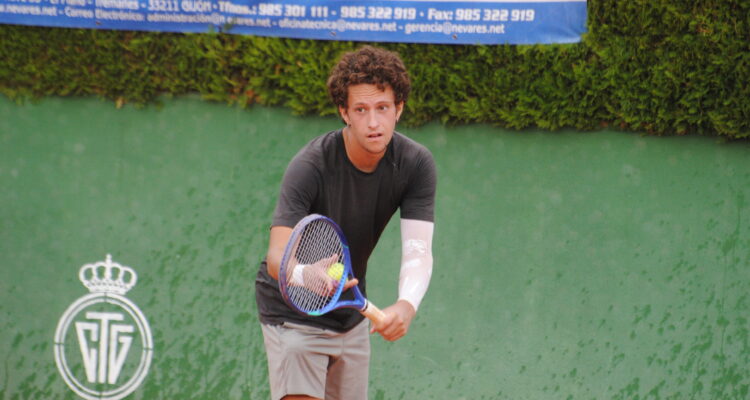
GIJON, September 9, 2026
For Richard Zusman, Tuesday’s first-round victory at the 62nd Torneo Dionisio Nespral in Gijón, Spain was about much more than simply advancing to the second round. The 26-year-old from the United States, currently ranked World No. 2386 with a career-high position of 1329, defeated Spain’s Alvaro Peiro Serrano after battling through qualifying – and in doing so achieved one of the main goals he had set himself following a lengthy injury lay-off.
The win had a special meaning because Zusman had faced Peiro Serrano at one of his final tournaments before his injury and lost. Shortly afterwards, he underwent surgery on his wrist and arm and did not compete again from the beginning of December until his return this season.
“I think one of my objectives coming back was to try to, by the end of the year, get an ATP Ranking point so I can compete next year,” Zusman explains. “Honestly, I wasn’t expecting it to come so fast. But, hey, I mean, I did the work, so I guess it paid off.”
His wrist and arm are now largely back to full strength, although he is still dealing with some shoulder problems resulting from the two surgeries.
“I would say, if not 100 per cent, 90 per cent more or less,” he says.
For a player who has spent years grinding his way through the ITF World Tennis Tour, simply getting back onto court has been an achievement. Zusman has been playing Futures-level events for around six years, competing seriously for the last four – excluding his year on the sidelines.
“It was a tough journey,” he says. “It took me, since I started my first Future until I got my first point, three, four years, many losses.
“My goal is now to try to start winning more consistently, main draw, getting more points, try to get a better ranking.”
At 26, Zusman is also conscious that his path is somewhat different from that of many of his opponents.
“A lot of the guys are 18, 19, 20,” he says. “So I would say, not that I’m in a rush, but, you know, I know that playing Futures, I probably won’t play until I’m 30. So I’ll try to get more points and better ranking.”
From New York to Barcelona
Zusman’s tennis journey began in New York, where his older brother was playing both tennis and basketball.
“When I was five, four or five, my brother was playing tennis and basketball and I just went to practice with him a few times,” he recalls. “And then I started like once a week and then once a week turned into twice a week. And eventually I just started playing every day almost.”
At 15, however, Zusman made a major decision. He left the United States for Spain, where he has lived ever since.
The reason was largely connected to his development as a tennis player. In his view, finding the right coaching environment and training group was more difficult in New York unless you were already part of the top USTA pathway.
“I think it’s hard to find like a stable base of a fitness coach or a tennis coach, good atmosphere,” he says. “I think it’s much more accessible here in Spain.”
He also noticed a fundamental difference in tennis culture.
“I think tennis is a much more popular sport here,” Zusman says. “So that’s why you have more opportunities, especially for people that maybe when they’re super young, aren’t super good.”
The move worked. Zusman has now made Spain his home, specifically Barcelona, while his parents remain in the United States.
“I just came when I was young and I liked it and I stayed,” he says. “And now we’re basically living here.”
His parents still visit regularly – increasingly so in recent years.
“Before it was like they would come once or twice a year. Now they come and visit me like four or five times a year.”
Sieh dir diesen Beitrag auf Instagram an
A different route through tennis
Interestingly, Zusman has experienced the reverse of what many European players do. While young Europeans increasingly move to the United States for college tennis, he went from the US to Spain as a teenager.
He nevertheless sees the US-American college system as an excellent route for young players.
“I think college tennis now is probably the best it’s ever been,” he says. “You see like so many players from college making it top 100, top 200. So I think it’s a good route.”
For Zusman, however, Spain offered what he needed at the time.
He combined online schooling in the United States with tennis training in Barcelona, attending a programme at BTT Tennis Academy that allowed him to train in the mornings while continuing his education.
“I just combined that and I was in like a real school kind of in the afternoons with online school,” he explains. “And then I could practice all the morning. So it was really comfortable to combine it.”
What makes Spain so special for him? “The quality of life. It’s a great country. Great weather, great food, good atmosphere,” Zusman says. Coming from New York, he also appreciates the lower cost of living.
“Crazy, I guess”
On court, Zusman describes himself in a similarly straightforward fashion.
“Crazy, I guess a bit,” he laughs when asked about his playing style.
When he was younger, he relied heavily on raw power.
“I was hitting the ball really hard compared to everyone, but I couldn’t control it. One day if I played really well, no one could play against me.”
That aggression remains a major part of his game, but experience has brought greater consistency.
“I’m the type of player who likes to dominate the point,” he says. “Like today in the match you saw, I was moving the guy.”
Away from the court, he tries to make the most of the limited free time that professional tennis provides. Beach trips, hiking, friends and family are important to him, as is cooking.
His speciality? Desserts. “Some pastries, I don’t know, cheesecake, tiramisu.”
Learning from the Challenger Tour
After years on the ITF Pro Circuit, Zusman has also had opportunities to experience the next level. One opponent who particularly stands out is Austrian Filip Misolic, whom he faced at the ATP Challenger in Tenerife.
“The first two games I won 2-0, but then after that I felt like he had just too much level for me to really do something,” Zusman recalls.
What struck him most was not necessarily a huge difference in shot-making, but the consistency and professionalism.
“The level is similar, but you see a difference in just like the consistency of the players,” he says. “Everyone’s so professional. Everyone comes early to warm up. Everyone stays after to cool down, physio, practicing more, practicing better.”
Those are the details he wants to incorporate into his own game and routine as he attempts to climb back up the rankings.
Inspired by Shapovalov, Federer and Alcaraz
With the US Open taking place during the ITF World Tennis Tour M25 event in Gijón, Zusman is keeping one eye on New York.
His favourite active player is Denis Shapovalov, partly because he identifies with the Canadian’s aggressive style.
“I kind of see like him and me, like similar game style, very aggressive,” he says. “When he plays well, he’s like really hard to beat.”
His childhood role model was Roger Federer, but more recently another player has become particularly relatable.
“Now, honestly, I see guys like Alcaraz or Sinner,” Zusman says.
The Spaniard’s return from injury resonates with him.
“Especially came back from injury and to see how well he’s doing. That’s like very, like, I feel with him because I also was like with the wrist so long.”
What impresses him most about Alcaraz, however, is the maturity behind the spectacular tennis.
“You just see the guy and it looks like he’s been playing tennis for like 100 years. He’s just so calm, collected, professional.”
The economics of professional tennis
The financial side of life on the lower levels is something Zusman knows well. He considers himself fortunate that his parents have been able to support his career without placing an overwhelming financial burden on the family.
“I’ve been super lucky,” he says.
But he also understands why the economics can become a major source of pressure for many players.
“Tennis is expensive. Even if you try to do it like super cheap, you’re spending a lot of money.”
And the prize money at the lower levels does not necessarily reflect the cost of competing.
“You see guys here, you win a tournament, you play like crazy, you put your body to the limit, you get injured or whatever. Okay, you win, you maybe make 4,000 for the week, but out of those 4,000, maybe you spend three and a half on expenses, hotel, flight and stuff.”
His conclusion is blunt.
“It’s a bit unfair, tennis, but what can you do?”
One point at a time
For now, Zusman is concentrating on making the most of the opportunity that has come his way in Gijón.
After qualifying and winning his opening-round match, he is already guaranteed the ATP Ranking point he had hoped to secure before the end of the year. His next target is clear: move towards the Top 1000, then eventually much higher.
“Maybe try to get into the Top 1000,” he says. “I think it can be a realistic goal.”
His longer-term ambition is to reach the Top 500 or 600 by the end of next year and earn more opportunities on the Challenger Tour.
For the remainder of the week in Gijón, Zusman is refusing to set limits. He expects a difficult second-round challenge, but believes his game is in a good place.
“If I can stay consistent, I think I can make a run, maybe quarterfinal, semis, because I feel comfortable. I think the conditions are also good for me.”
After everything he has been through, the message is simple: “Honestly, just keep pushing.”