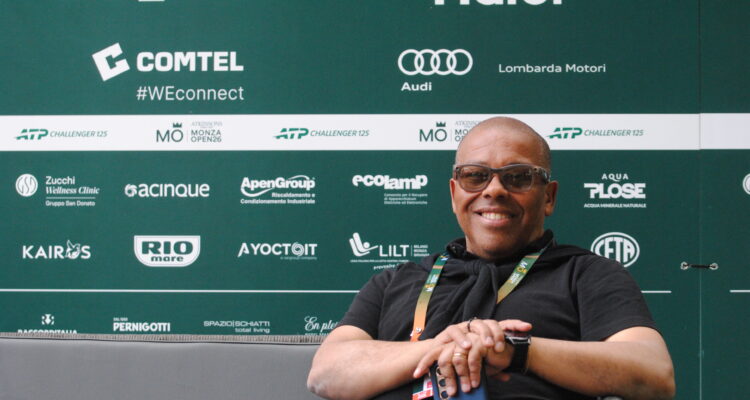
MONZA, April 14, 2026
After more than 30 years on the ATP Tour and over 8,000 matches officiated, renowned Brazilian umpire Carlos Bernardes brought his career to a close at the ATP Finals 2024 in Turin.
A familiar and respected figure in tennis, he oversaw some of the sport’s biggest matches, including the Wimbledon final in 2011. Now based in Bergamo, Italy Bernardes remains involved in tennis, working as a tournament director on the ATP Challenger Tour. We caught up with him on the sidelines of the Monza Open.
Tennis TourTalk: What brings you here to Monza?
Carlos Bernardes: My wife is working here as part of the official review team, and I had the chance to come as a visitor. I was here last year, and it was nice, but this year the organizers are doing an unbelievable job. The stands have been packed since Sunday when qualifying started. It’s great to see people coming out to watch tennis – not only the Italian players, but the sport in general.
You’re now also involved in the Challenger Tour as a tournament director. How was your experience at the Romagna Cup in Cesenatico, Italy?
It was very nice and interesting to see the perspective of the organizers. You have to interact a lot with the players. The team there did a very good job. At that time of the year, there is usually nothing going on in that region—many hotels are closed and the city feels like a ghost town. Because of the tournament, a lot of people came, and it was very successful. The mayor and the city representatives were very happy. Overall, it was a great experience. I will also be tournament director at the Challenger event in Cervia in May.
What surprised you the most in your new role?
I was surprised that some players don’t really know the procedures. Especially those coming from lower-level events – they don’t always read the fact sheet, like deadlines for hotel reservations or what happens if you miss them. I had quite a few conversations with players about the rules.
Sieh dir diesen Beitrag auf Instagram an
How will the ATP Challenger tournament in Cervia differ from the one in Cesenatico?
It will take place at the beginning of the high season, so the weather will be better and it will be played outdoors. I think we will have more spectators, as the days are longer and there are more hours of sunshine. Let’s see how it goes.
When you attend a tournament like this, do you miss being in the chair?
No (laughs), not the umpiring itself, but the people. I met some colleagues here that I haven’t seen in more than 10 years. That’s really nice.
You also started at Challenger level. What are your memories from those early days?
There are a lot of funny stories. For example, we once stayed in a hotel with no stars – the only star was you (laughs). It was raining and we had water in our room, it was a disaster. Back then, we often shared rooms – two, three, even four people – to save money. It’s amazing to see how professional the tour has become. I’ve been around for 40 years and have seen how much conditions have improved for players and officials.
Are you still in touch with other officials?
Yes, with some of them. Sometimes I watch matches on TV and comment on their decisions (laughs). Because of the calendar, you saw some colleagues only a few times a year, while others you worked with almost every week. For many of today’s umpires, I was a kind of teacher at some point. It’s like a second family – you often spend more time with them than with your own family.
With all the new technology in tennis, how do you see the role of the chair umpire in the future?
This goes beyond sport – it affects everyday life. With artificial intelligence and automation, things are changing. For umpires, communication with players about line calls is mostly gone. Their role is now more about explaining what’s happening on court to the crowd or TV. It’s completely different from when we started as line umpires. Back then, we learned a lot from the chair umpire. Now players don’t really have excuses for decisions anymore – it’s their own responsibility. It’s a challenge for everyone.
If you had to buy a ticket for one match, which one would it be?
I really like Alexander Bublik and his style of play. He can put on a great show with his technique and is dangerous for anyone. I also like Carlos Alcaraz and his creativity on court. There aren’t many “magicians” left like Fabrice Santoro. But Bublik against Alcaraz – that’s a match I would definitely watch.
Thank you and all the best.
Interview: Florian Heer