AUGSBURG, August 25, 2026
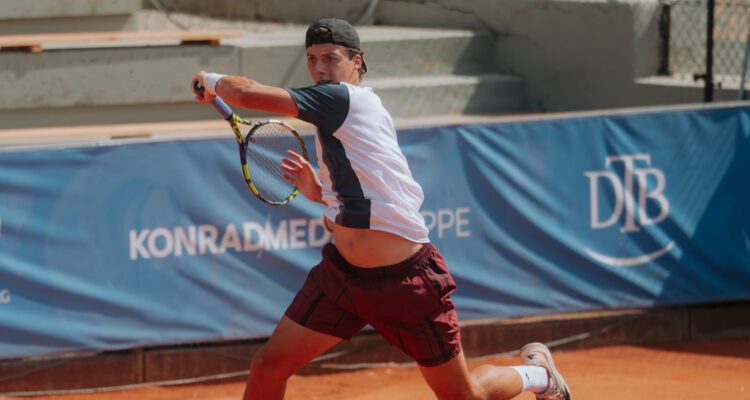
Benito Sanchez Martinez is back in Augsburg, and the setting could hardly be more familiar. The 24-year-old German, currently ranked world No. 1002 after reaching a career-high of No. 839 last year, enjoyed a memorable run at the Schwaben Open by Great2Stay 12 months ago. He came through qualifying and reached the quarterfinals before teaming up with Daniel Masur to win the doubles title of the ATP Challenger 50 event.
Sanchez Martinez also has a first Pro Tour title to his name. In 2024, he lifted his maiden trophy in Fayetteville, USA. Much of his recent development, however, came away from the traditional tournament circuit. He spent four years playing college tennis for Mississippi State University, where he completed a bachelor’s degree in Business Administration.
His Spanish name reflects his family background: his father is from Cuba, while his mother is German. After returning from the United States and completing his college career, Sanchez Martinez is now embarking on the next chapter of his tennis journey.
Back in Augsburg, where he has already made it through qualifying again, Sanchez Martinez spoke about his return to the professional tour, the lessons he learned during his time in the United States, his plans for the future, his goals in the ATP Rankings and why the Schwaben Open by Great2Stay is a tournament he particularly enjoys coming back to.
Tennis TourTalk: Benito, you’re back in Augsburg. You had a good run here last year and have now made it into the main draw again. How do you feel about being back and what are your impressions of the tournament?
Benito Sanchez Martinez: Every time I have played here, I have managed to qualify for the main draw, which is obviously great for me. It also gives me a good start to the main draw. You don’t go into your first match completely cold. You come in with a certain amount of confidence because you already know that you have played two good matches.
I also feel very comfortable here. I knew that beforehand and I was looking forward to coming back. I feel very comfortable at the club, just as I did when I played doubles here last year. Hopefully, it will be the same this year.
I also like Augsburg as a city. I feel comfortable here and the atmosphere suits me. The weather has been good so far as well, so hopefully it stays that way for the rest of the week.
Last year, you won the doubles title here. Did you even have time to celebrate?
Not really, to be honest. I was only able to play the tournament because my coach called me. At the time, I was still in the United States studying, and he told me that I had received a wildcard for the doubles main draw.
I said, “I’ll come a week later. Is that okay?” And he said, “Sure, just play and come when you’re finished. But you have to be here by Sunday at the latest.”
Then Sunday got closer and closer, but we were still in the tournament. Eventually, we reached the final. We won the tournament on Saturday, took the train back immediately and I left again the next day.
Daniel also went straight on to his next tournament. After that, we didn’t see each other for a long time – basically until May or June this year.
Sieh dir diesen Beitrag auf Instagram an
You played a lot of Bundesliga this season and only returned to the professional tour regularly in June. How much did the Bundesliga help you get back into a rhythm?
Definitely. Especially for me, coming back from college, it was a good springboard into the summer season and also into playing on clay.
You get a lot of matches without having the pressure of thinking, “I have to win this match or my week is basically over.” Otherwise, you’re kind of stuck between tournaments and don’t really know what to do – whether to keep training, stay in one place or travel straight to the next tournament.
In the Bundesliga, you usually have matches on Friday and Sunday. Then you train until Friday and have matches again. It’s somewhat similar to college, but for me it’s on clay, which is obviously great.
I had a lot of good matches this season. In the German Bundesliga, I played mostly at No. 3 or No. 4, but even there you face very strong opponents.
That gives you a good foundation to feel comfortable at this level, for example at a Challenger like this one in Augsburg. It’s not like I come here and think, “Wow, this level is overwhelming me.” The players are obviously very good, but I feel like I know this level and can compete with these guys.
You mentioned college. What ultimately made you decide to go to the United States and play college tennis?
Basically, I was against it at first. My priority was to finish my Abitur (high school diploma). I think you need a second option or something to fall back on. That’s important.
I went to a sports school in Hanover, where there were a lot of athletes, including footballers from Hannover 96 and other clubs. You see some athletes who basically do school only as much as they have to and then focus entirely on sport.
But you never know what can happen. An injury can take you out of sport, and suddenly you might not be able to compete at the level you want or need to be at to become a professional.
Then you ask yourself, “What do I do if I don’t have anything academically?” At least I had my Abitur, which meant I could go to university. And now I also have a bachelor’s degree.
So I could easily do a master’s degree or find a job. That also means I don’t have as much pressure. I know that I can give everything to tennis. If I make it, that’s great. And if I don’t, obviously that’s disappointing, but I can still move forward.
How do you decide which college to attend? Did you have several options and did scholarships play a role?
As I said, I wasn’t interested in college at first. I actually wanted to finish school and then play tennis.
That’s why I unfortunately ignored a lot of inquiries from universities or told them, “No, I don’t want to play. Thank you for the invitation.”
Universities actually approach young players directly. If you play a lot of ITF junior tournaments and achieve relatively good results, you quickly become a player that universities are interested in.
Nowadays, many more players go to college because the level has become very strong. The best college players are around the Top 300 or Top 400 level and have the quality to compete there.
Ultimately, personal preferences also play a role. How do you know the coaches? You have conversations and phone calls, and sometimes you can make an official visit. You can look at the facilities, see how the training is structured and what opportunities you have.
For me, it was a relatively quick process because I decided to go to college at very short notice. So I didn’t have that many options, especially because I had previously told everyone that I wasn’t interested.
Luckily, I still had the opportunity to speak to two or three universities, and in the end I decided to go to Mississippi State.
Sieh dir diesen Beitrag auf Instagram an
Is doing a master’s degree still an option, or is the professional tour your priority now?
For now, I would like to spend one or two years on the professional tour.
If I realize that things aren’t progressing the way I want and that perhaps it’s coming to an end, then doing a master’s degree online could be an option. Or if I decide to stop playing professional tennis altogether, I could go back to university and do it properly.
So yes, it’s definitely an option. But from where I stand right now, it’s not my priority.
So the goal is the professional tour. What does your structure look like? You are based in Berlin and have coaches there.
I had to build my own structure. I have my own coach, and of course my club coaches at SCC Berlin are there as well. They always support me, especially when I have time between tournaments. I can train there whenever I need to.
I also have a private coach and a fitness coach. I have had to build all of that step by step.
For now, I want to see how this structure works. If I feel that it’s good and that I like it, I’ll keep it. If I realize that I need to make some adjustments – perhaps in terms of training or facilities – then I’ll have to make those changes.
Now that the Bundesliga is over, I’m really starting to play tournaments again. My base is currently in Berlin, and I’ll be operating from there.
Will your coach also travel with you to tournaments?
In Germany, definitely. Across Europe, I’ll have to see.
If I’m playing smaller tournaments, I don’t necessarily need him there. I’ve already played a lot of matches by myself.
But at bigger events it’s different. He came to Halle for the ATP 500 this year, and he was also in Braunschweig.
At those tournaments, it’s important that he sees the higher level himself. Then we can identify what you need to play at that next level and what qualities those players have. If my coach sees it himself, we can work on it much better.
How would you describe your playing style, and what do you still need to work on?
I think my game is relatively balanced. If I want to, I can play fast and flat and stand close to the baseline. That’s something I took from my four years at college.
At the same time, I’m trying to play more longer rallies, with more spin and more height over the net, rather than trying to rush the point.
I can also play for a long time. I think I have a good foundation in that respect, and I also have the mental strength for it.
In the end, I think what I’m missing – and what many players are missing – is consistency. The difference in terms of strokes isn’t huge between the players competing here and those you see at an ATP 250.
Of course, the ATP Tour players serve faster consistently and hit the corners much more often. They can serve much more precisely. But ultimately, they aren’t doing something completely different from what I’m doing.
It’s really about being able to reproduce the good tennis. When someone says, “I played really, really well today,” you need to be able to do that every day.
It’s not about reaching that level once. You have to be as consistent as possible – not just for one tournament, but for three months, an entire season, a year and eventually for several years.
That’s the difference between a good player and an excellent player.
I think I’m currently trying to find my game and set that level as my benchmark. That’s where I want to get to.
I’ve had some matches in the Bundesliga where I reached that level. Now I have to work on being able to produce it consistently.
Do you have a specific goal for your world ranking?
Definitely. First of all, I want to start playing tournaments regularly again. I was in America and barely played tournaments for years.
Over the next two years, my goal is to break into the Top 400. I think that’s a realistic goal.
It’s not that I’m saying, “I want to be Top 200 immediately.” Of course, that would be a great goal, but I want to keep it realistic for myself. I don’t want to set the bar so high that I’m completely disappointed if I don’t reach it.
Top 400 is a realistic goal for me.
You have an international family background. Your father is from Cuba. How did that come about?
As you mentioned, my father is Cuban. He moved to Germany with his entire family when he was relatively young, to what was then East Germany.
On my mother’s side, the family is German. My mother is from Berlin. My father later moved to Berlin and met my mother there.
That’s basically the background.
Have you ever been to Cuba yourself?
No, not really. I was only there when I was very, very young – I was eight months old. But I haven’t had the opportunity to go back since.
It’s obviously quite a long way. It’s not like taking a Ryanair flight and flying over for a few euros.
But it’s definitely still on my list. I would really like to go there. Ideally, I would go with my family and show my father where he grew up and where he lived. And, of course, experience the culture as well.
You mentioned that your family didn’t really teach you Spanish actively. Can you still get by with the language?
Yes, definitely. I grew up with it. My father spoke a lot of Spanish at home, and much of his family lives in Spain.
So I’ve always been around the language. I never really learned to speak it actively, but I understand a lot and I would definitely be able to get by.
What do you like to do away from tennis? What are your hobbies?
I really enjoy listening to music. I have a pretty big passion for it.
What kind of music do you listen to?
A lot of different things. It depends on my mood. I like jazz and classical music, but I also like house music and techno – being from Berlin, that probably makes sense. I also enjoy rock.
And when I have the time, I like playing video games. That’s something I grew up with as a kid.
Otherwise, I enjoy spending time with my girlfriend. She’s here in Augsburg with our dog.
You have a dog. What’s her name and what kind of dog is she?
She’s a Golden Retriever and her name is Luna and is six years old.
We spend a lot of time together and obviously like going for walks. It’s nice having a dog when you can find the time for it.
I enjoy walking in the woods or in the countryside, especially outside Berlin or in the Grunewald.
During a tournament week, are you someone who likes to explore the city, or are you more of a hotel-and-tennis-court person?
I definitely like exploring. Especially when I’m traveling with my girlfriend, I enjoy discovering a city together. It’s nice when you can share those experiences with someone.
If I’m traveling alone and the place doesn’t particularly appeal to me, then it’s more like: tournament, tennis club and hotel – maybe a trip to the supermarket every now and then.
But generally, I like exploring. I’ve enjoyed doing that here in Augsburg with my girlfriend as well. It’s actually on the list for today. I have a little bit of time because I don’t have a doubles match today.
So I’ll probably head into the city again during the week.
Enjoy your stay and thank you for the interview.
Interview: Florian Heer