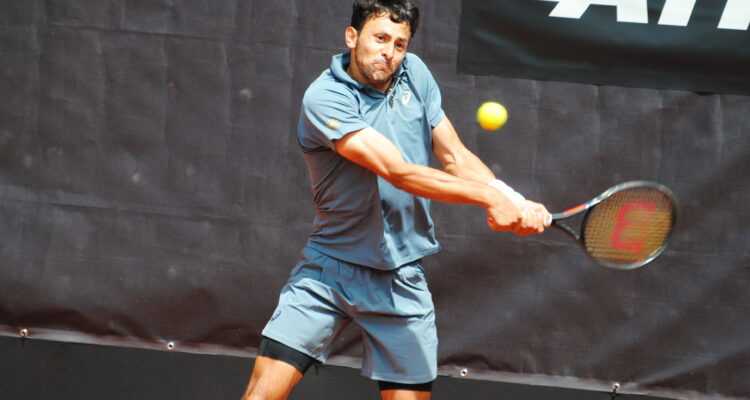
BAD RAPPENAU, June 6, 2026
Emilio Nava is one of the many US-American players contributing to the remarkable depth of U.S. men’s tennis. After winning four ATP Challenger titles in 2025 and continuing his rise up the rankings, the 24-year-old Californian has established himself as one of the most consistent performers on the Challenger circuit.
Nava arrived at the Neckarcup as the tournament’s second seed and one of the most exciting US-American players on the ATP Challenger Tour. The current World No. 94 comes from a sports-loving family with Mexican roots. His mother was a professional tennis player, while his father Eduardo represented Mexico in athletics at the 1988 Olympic Games. His brothers Eduardo and Diego both played college tennis, and his cousin Ernesto Escobedo also enjoyed a successful career on the ATP Tour.
In Bad Rappenau Nava spoke about the strength of the current generation of US-American players, the challenges of life on tour, his training bases in Argentina and Florida, and his ambitions for the future. He also shared his thoughts on football, video games, and why he believes US-American players are proving they can thrive on clay courts just as well as on hard courts.
Tennis TourTalk: Emilio, there are currently 17 US-American men in the Top 100. What’s the secret behind the success of U.S. men’s tennis?
Emilio Nava: We’re just good players (laughs). Look at guys like Ben Shelton, Taylor Fritz, Tommy Paul, Frances Tiafoe, Brandon Nakashima and Alex Michelsen. They’re all doing great. We get along well, but we’re also extremely competitive. We push each other every day to become better players. Having guys in the Top 10 motivates everyone else. You look at what they’re doing and think, “Why not me?” American players are very competitive and we want to win. Hopefully we’ll also have a strong Davis Cup team this year.
US-American players are traditionally associated with hard courts, but many of you are now also succeeding on clay. Why is that?
Just look at this year’s French Open. Americans are making deep runs. Tommy Paul has always been very consistent on clay. Ben Shelton has improved a lot. The stereotype that Americans can’t play on clay isn’t really true anymore. We’re getting better on all surfaces and we’re proving that every year.
Do you spend much time together with the other US-American players?
Everybody has their own team and their own coach, but we’re still close. We’re friends off the court and competitors on it. I think that’s healthy. George Goldhoff is here as well and he’s a cool guy.
You also seem to spend a lot of time within the Spanish-speaking community on tour.
Yes, definitely. My coach is from Spain and my physio is Argentinian, so naturally I spend a lot of time around Spanish-speaking people.
Many Challenger players don’t have the luxury of traveling with a full team. There has been discussion about increasing prize money at lower levels. What’s your view?
I’ve played Challengers without having a real breakthrough yet, and there are players who have had it much harder than me because of injuries or financial difficulties. If someone wants to give us more money, I’ll take it (laughs). But seriously, I think it’s important that players like Jannik Sinner and Aryna Sabalenka have spoken about these issues. Hopefully the people who make decisions are listening. We’re traveling to a new country every week and competing constantly. It’s not easy. I’m definitely on the players’ side.
Your cousin Ernesto Escobedo played the Neckarcup a few years ago. Did he tell you anything about the tournament?
We talk pretty often, but I didn’t know that. Ernesto and I are very close. He retired from professional tennis and is based in Los Angeles now. He was a great player.
Last year you won four Challenger titles. Was that your breakthrough season?
It was definitely my best season so far and I’m proud of what I achieved. Winning four Challenger titles is something special. But I still think my real breakthrough at ATP Tour level is ahead of me. These things don’t happen overnight. I just need to keep investing in myself, my coach, and my physios, keep doing the right things, and not be too hard on myself.
You’re often based in Argentina. How does your training setup work?
I have a base in Buenos Aires and another one in Florida. It depends on the schedule. I usually choose whichever location makes the most sense for the tournaments I’m playing.
What language do you think in on court?
Nava: Mostly English. I speak Spanish with my coaches, but English is still my primary language.
What do you enjoy doing away from tennis?
I love video games. Right now, I’m playing a lot of Battlefield. I also enjoy going to the beach, relaxing and spending time with friends. Tennis is a huge part of my life, but it’s important to have other interests too.
The FIFA World Cup is coming up. Do you follow football?
The more time I spend in Argentina and Spain, the more I’ve started to enjoy football. It’s a great sport. I support Atletico Madrid. As for the United States national team, I always back them. Hopefully they can surprise some people.
When you travel so much, do you also get a chance to explore the places you visit?
I’m trying to do that more often. We travel to all these amazing places but sometimes we only see the hotel and the tennis club. I’d like to learn more about the history and culture of the cities and countries we visit.
Germany plays the United States on Saturday. What’s your prediction?
Hopefully we win. Simple as that (laughs).
Thanks for your time.
Interview: Florian Heer